


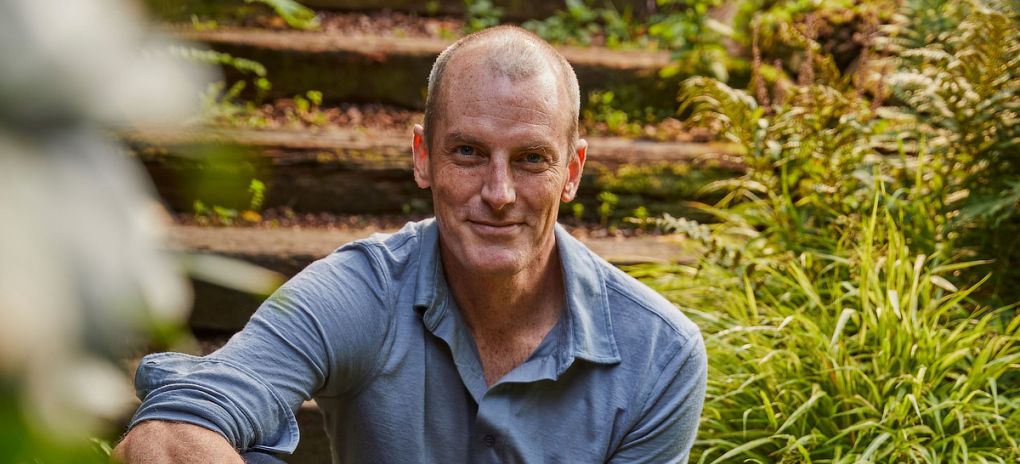
09/03/2026 Paul Mathew, conservation biologist, former bartender, and founder of Everleaf, speaks to us about texture, terroir, and the future of the glass.
Some drinks quench a thirst, and then some drinks tell a story.
Everleaf, the award-winning non-alcoholic aperitif brand founded by Paul Mathew, belongs firmly in the second category. Drawing on his dual background as a conservation biologist and bartender, Mathew has spent years asking a question the industry had largely overlooked: not what you take out of a drink, but what you can build in from the very beginning.
THE MISSING DIMENSION: TEXTURE
When Everleaf launched, the non-alcoholic category was growing, but Mathew saw a gap that few others had identified.
"One of the first things I wanted to focus on was texture, something I felt was missing from non-alc at the time we launched," he explains. "As a bartender, it's one of the key components I look for in a drink, but it doesn't get as much attention as flavour and aroma."
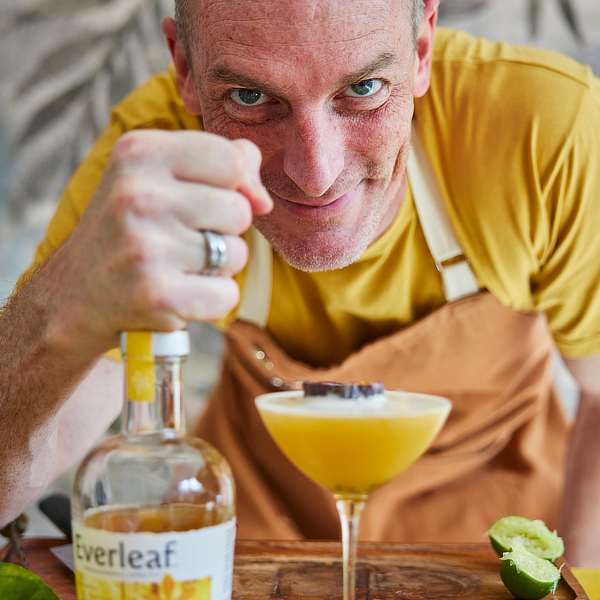
The pursuit of that elusive mouthfeel was no small undertaking. Mathew spent around 18 months working with plants, dehydrating them, grinding them up, heating them in different ways, searching for the right result. Early experiments went spectacularly wrong. "Some of the first experiments precipitated, or split into a cloudy half and a clear half. Some even set solid!" he recalls.
The outcome, once achieved, was something subtler than a diner would consciously notice, but profoundly felt. "Whilst it's not something that's immediately noticeable in a drink, texture is a really important part, helping flavours develop on the palate and improve the finish. It gives a more grown-up drinking experience."
CONSERVATION BIOLOGY AS A FLAVOUR COMPASS
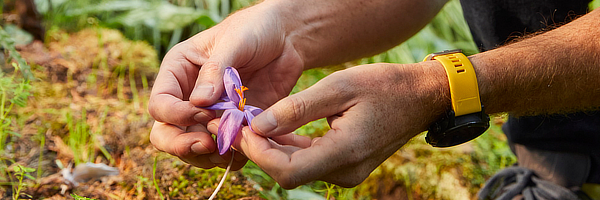
Most drink brands begin with a flavour brief. Mathew began with a field notebook. His scientific background, alongside his botanist father, gave him something extraordinary: access to thousands of plants as potential ingredients.
"It's a bit like having a back bar of thousands of flavours to play with as a bartender," he says. Across the three Everleaf expressions, that library has been tapped for everything from immortelle in Mountain to labdanum in Marine, botanicals that most drinkers, and indeed most drink makers, would never think to reach for.
But biology also carries a responsibility. Sourcing sustainably is non-negotiable for Mathew. "I want to make sure we use plants sustainably, so they're around forever," he explains. The brand stopped using quassia for bitterness when it couldn't find an appropriate supplier.
Mathew has visited Madagascar in person to meet the farmers growing Everleaf's vanilla and to see the sustainability initiatives their supplier supports on the ground.
THREE BIOMES, INFINITE MEMORY
Everleaf's three expressions, Forest, Marine, and Mountain, are each anchored in a global biome. It is a device that does double duty: shorthand for complex botanical profiles, and an invitation to the drinker's own imagination.
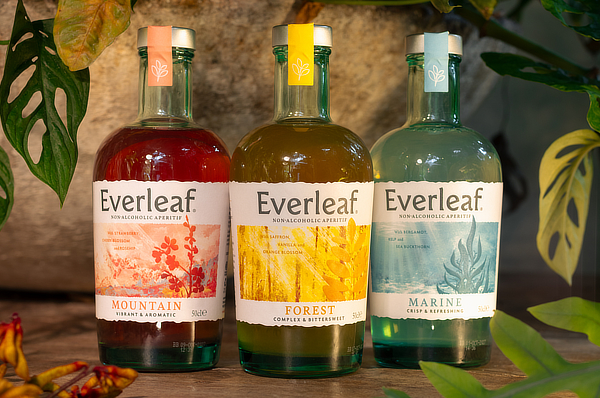
"We use around 50 different plants across the three Everleaf flavours," Mathew says. "It's not going to make a lot of sense to people if I list them out on the side of the bottle, so the biomes are a way of explaining the character and flavours differently."
Each expression carries a personal memory.
- Marine captures "that saline umami you get at the back of your nose when you've been in the sea, followed by the fresh citrus and aromatic herbs you get when lying back on a Mediterranean beach afterwards, surrounded by hills of bergamot and olive groves."
- Mountain was born from bicycle rides into the hills during Mathew's time living in China. "Starting in valleys of spring cherry blossom at the base, then exploring the mountain herbs and berries on the way up to the summit, it's vibrant and aromatic, but also savoury and a little bitter."
- Forest, the original expression, draws on years of fieldwork as a conservation biologist. "The flavours come from the flowers blooming at the top of the canopy on the nose, followed by the rich spice of the trees and diversity of plants in the different layers of the forest as you descend: cinnamon, cassia, vanilla in the mid palate, ending in the earthy, bittersweet roots of the forest floor at the finish."
A NEW OCCASION, NOT A SUBSTITUTE
Everleaf occupies a distinctive philosophical position in the non-alcoholic landscape. Where many brands launch as analogues, including a non-alc gin or a spirit-free whisky, Mathew has always resisted that framing.
"My approach has always been to create great-tasting drinks that fit an occasion rather than trying to copy a spirit," he says. "I don't want to make a 'non-alc gin' or similar, as you're immediately missing 40% or so of what makes that product what it is. It's always going to be something less than the original."
His alternative is to reason from the occasion upward. "What would I like to drink on the occasion when I would otherwise have a gin and tonic? Something complex, interesting, with a good nose, satisfying flavour, some bitterness, and a long finish, then work on building that up. Adding, not taking away."
THE FUTURE OF THE GLASS
As a founder who has watched the non-alcoholic category evolve across nearly a decade, Mathew's vision for its future is expansive, and perhaps surprising in its ambition.
"I'd love for it to become even more normalised to the extent that it isn't a separate category. We just end up with a spectrum of delicious drinks, some of which are full strength, some mid, and some non-alc, across every category: beers, wines, and spirits," he says.
Beyond normalisation, he sees a broader diversification underway. In the USA, functional alternatives to alcohol are "just exploding." In China, venues are exploring traditional medicinal plants in cocktails. Here in the UK, non-alcoholic drinks that support gut health are growing rapidly. "It's a really exciting time," Mathew concludes, "to be exploring what the future of drinks might look like."
Everleaf Forest, Marine, and Mountain are available online and at leading bars and retailers - visit - everleafdrinks.com
Get evaluated by leading U.S. bartenders and beverage buyers. Enter by September 30 and save $100 per spirit.